
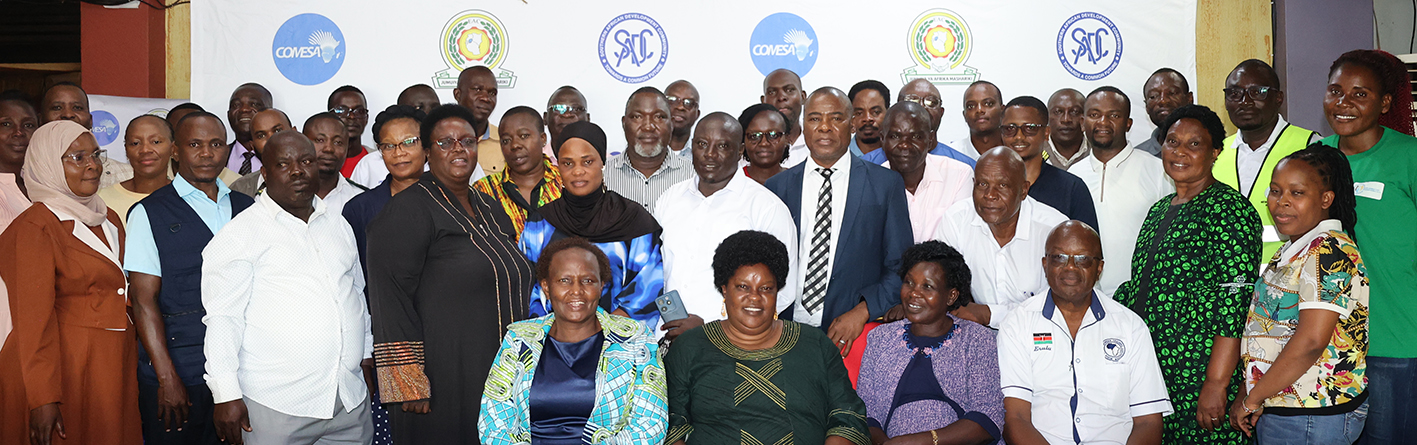
The Common Market for Eastern and Southern Africa (COMESA), the East African Community (EAC) and the Southern African Development Community (SADC) on 16 November 2026 commenced a two-day capacity-building and awareness-creation workshop on the Tripartite Simplified Trade Regime (TSTR) at the Busia/Busia One Stop Border Post between the Republic of Kenya and the Republic of Uganda.
The workshop forms part of regional efforts to make cross-border trade easier, faster and more affordable, particularly for small-scale and informal traders who often encounter administrative and procedural barriers when moving goods across borders. It brings together government representatives, border agencies, Trade Information Desk Officers (TIDOs), Cross-Border Traders Associations (CBTAs), Joint Border Committees (JBCs), small-scale traders and other relevant stakeholders from the Tripartite area.
Opening the workshop, Mr Evariste Munyampundu, EAC Procedures and Trade Facilitation Customs Officer, representing the East African Community (EAC) in its capacity as Chairperson of the Tripartite Task Force (TTF), highlighted the considerable economic potential of the Tripartite region, comprising 29 Member States, a population of more than 800 million people, and a combined Gross Domestic Product exceeding US$1.2 trillion.
He added that, despite this substantial market, intra-regional trade remains below its potential, while small-scale traders continue to face complex tax and customs procedures, high transaction costs, limited access to markets and trade information, harassment and delays at border posts.
The Chairperson emphasised that the TSTR must translate into practical benefits for traders through procedures that are understood by border officials and accessible to the people it is intended to serve. The Regime provides for simplified customs documentation through the Simplified Certificate of Origin and Simplified Customs Declaration, alongside clear eligibility requirements for goods traded under the arrangement.
The first day of the workshop focused on the policy and regulatory framework underpinning the TSTR. Participants examined the Tripartite Free Trade Area, including its background, objectives, trading instruments and implementation status. The sessions also provided an overview of the Simplified Trade Regimes of COMESA, EAC and SADC, highlighting their respective objectives, key features, implementation experiences and achievements.
Further discussions explored the TSTR framework, with particular attention to eligibility criteria, product lists, trade thresholds and institutional arrangements. These sessions provided participants with an opportunity to understand the requirements governing the Regime and their respective roles in facilitating its implementation.
The programme also incorporated practical group exercises designed around real-life trading scenarios under the Tripartite Simplified Trade Regime (TSTR). The exercises covered key aspects of the regime, including trader eligibility requirements, applicable consignment thresholds, Rules of Origin, customs procedures, and the completion of Simplified Customs Declarations and Simplified Certificates of Origin. Participants also engaged in discussions on the development of Standard Operating Procedures (SOPs) for Trade Information Desks, as well as resource mobilisation and sustainability planning. Facilitating these sessions, Mr Rangarirai Machemedze, Project Coordinator for the TSTR, emphasized that the TSTR should be viewed not only as a trade facilitation instrument that simplifies cross-border trade for small-scale traders, but also as a development catalyst that promotes value addition, regional industrialisation, and trade in manufactured products originating within the Tripartite region. He further highlighted the importance of equipping border officials and trade support structures with the knowledge, tools, and resources necessary to effectively support small-scale traders and maximise the developmental impact of the regime.
The initiative is funded by the Alliance for a Green Revolution in Africa (AGRA) under a project supporting the implementation of the Simplified Trade Regime within the Northern and Nacala Trade Corridors. It places particular emphasis on women and young people, who account for a significant proportion of small-scale cross-border traders and often face additional barriers to participating in formal trading systems.
Through the pilot implementation of the TSTR at selected border posts in participating Member States, COMESA, EAC and SADC seek to reduce the time and costs associated with cross-border trade, improve access to trade-related information and expand economic opportunities for small-scale traders across the region.


